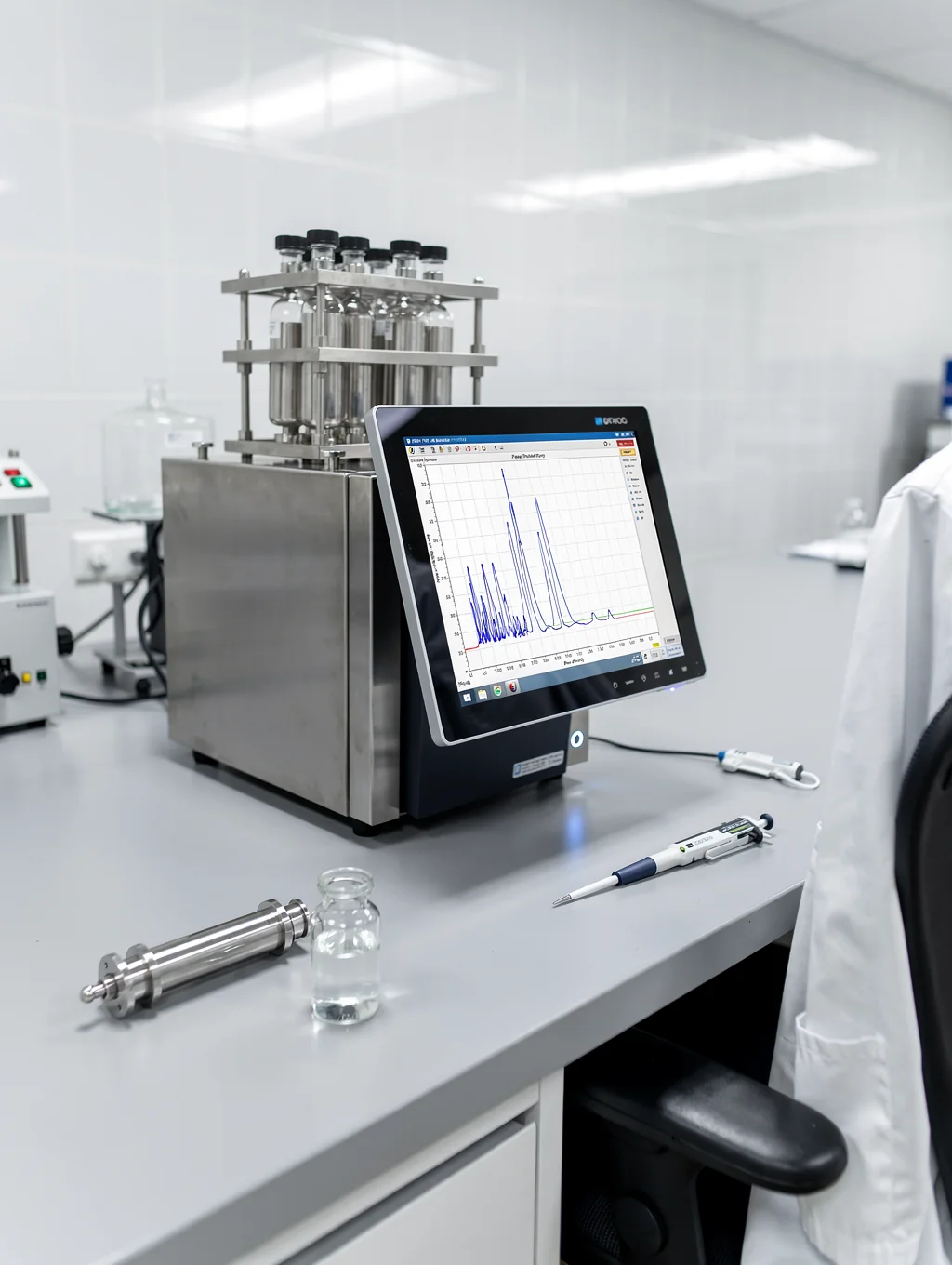
Solid-phase peptide synthesis and lyophilization protocols
Our laboratory utilizes orthogonal Fmoc/tBu solid-phase methodologies to build target amino acid sequences on insoluble matrix supports. Acid-labile linkers allow controlled cleavage via concentrated trifluoroacetic acid (TFA) cocktails with tailored scavengers, preventing re-attachment of reactive side-chain protecting groups.
Following ether precipitation and primary centrifugal isolation, crude peptides are channeled through dual-wavelength preparative reverse-phase columns (C18 silica matrix). Subsequent deep vacuum lyophilization removes volatile counter-ions, yielding stable, moisture-controlled reagents ready for reconstitution.
Solid-phase assembly
Fmoc chemical synthesis
Stepwise chain elongation on polystyrene resin cores with automated optical coupling verification.
Preparative RP-HPLC
Reverse-phase purification
Acetonitrile gradient fraction collector separating truncations and diastereomeric impurities.
Lyophilization & assay
Vacuum drying & LC-MS
Multi-day deep vacuum dehydration yielding sterile cakes, followed by ESI mass spectrometry validation.
Investigational domains
Comprehensive categorization of scientific research domains using pure peptide reagents for laboratory-verified analytical testing.
- Quantify GPCR activation thresholds and downstream kinase cascades.
- Evaluate competitive ligand kinetics in stable cell lines.
- Monitor incretin-receptor modulation in isolated pancreatic islets.
- Track glucose uptake markers across cultured myocyte systems.
- Analyze fibroblast migration assays and procollagen deposition.
- Measure matrix metalloproteinase inhibition in tissue scaffolds.
- Assess synaptogenesis pathways in primary hippocampal neurons.
- Probe blood-brain barrier transport dynamics in transwell models.
- Determine minimum inhibitory concentrations (MIC) on bacterial strains.
- Quantify membrane permeabilization using fluorescent dye uptake.
- Synthesize calibrated epitope targets for selective antibody profiling.
- Validate cytokine release assays in stimulated PBMC cultures.
Quality standards & compliance
Review our analytical release specifications, cold-chain transport parameters, and research-use verification guidelines.
Every synthesized batch must meet or exceed a minimum threshold of 98.0% purity as determined by reversed-phase high-performance liquid chromatography. We do not release peptide lots with unverified impurities or ambiguous mass spectral peaks.
| Testing parameter | Release specification |
|---|---|
| Purity by RP-HPLC | >= 98.0% (standard) / >= 99.0% (analytical) |
| Identity confirmation | Observed mass matches theoretical [M+H]+ within +/- 1.0 Da |
| Trifluoroacetic acid (TFA) | <= 1.0% residual content (acetate exchange optional) |
| Moisture content (Karl Fischer) | <= 5.0% w/w lyophilized powder |
| Solubility verification | Complete dissolution in sterile bacteriostatic water |
Require specific synthesis limits or custom analytical certificates?
Our technical staff supports institutional inquiries across all major research centers in India.